Natural vs. Medicated Acne Treatments: What the Evidence Actually Shows
Medically reviewed by Dr. Rachel Torres, MD, Pediatric Dermatologist
Written by Teen Acne Solutions Editorial Team — Updated April 16, 2026
Key takeaways
- Tea tree oil (5%) performed comparably to benzoyl peroxide (5%) in a controlled trial — but it worked slower and most store-bought products contain far less than 5%.
- Benzoyl peroxide and salicylic acid remain the strongest over-the-counter options with decades of clinical data, though side effects like dryness and irritation affect 30-50% of users.
- Most 'natural' acne products rely on ingredients with little to no clinical evidence — the word 'natural' on a label tells you nothing about whether it works.
- The best results often come from combining approaches — using evidence-backed natural ingredients alongside proven medicated treatments, with guidance from a dermatologist.
Your best friend swears by the honey mask she saw on TikTok. Your dermatologist handed you a prescription for tretinoin. Your mom bought you a "natural" face wash that costs $34 and smells like a garden. And your skin still looks the same.
So which side is right — team natural or team medicated? The honest answer is messier than either camp wants to admit.
The Natural Treatments (Sorted by Evidence)
Not all natural ingredients are created equal. Some have real clinical trials behind them. Most don't. Here's what the research actually says — ranked from "genuinely promising" to "nice idea, no proof."
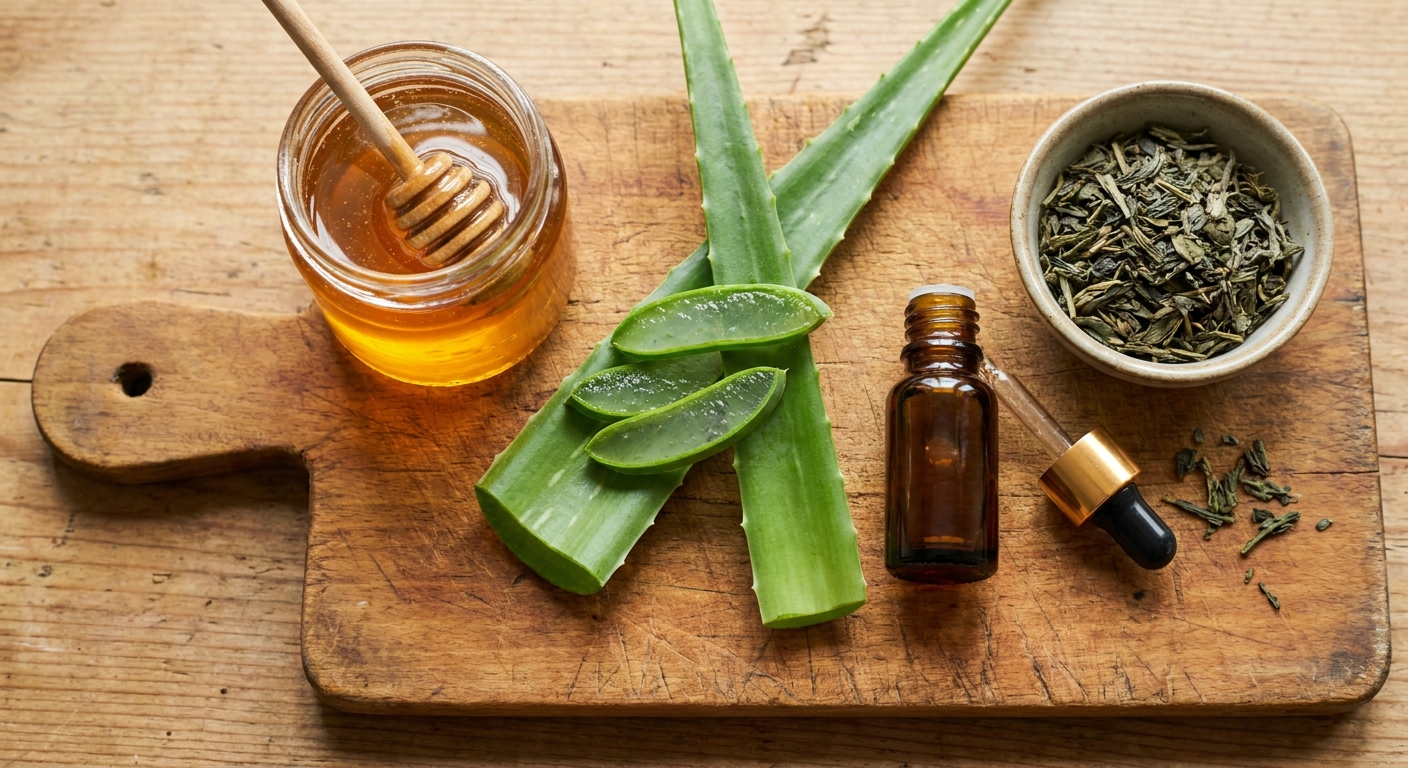
Tea Tree Oil — The One That Actually Has Data
This is the standout. A 1990 study in the Medical Journal of Australia compared 5% tea tree oil gel to 5% benzoyl peroxide lotion in 124 patients with mild to moderate acne. The results surprised a lot of people.
Both treatments significantly reduced inflamed and non-inflamed lesions. Tea tree oil worked slower — it took about twice as long to kick in — but it caused far fewer side effects. Less dryness. Less peeling. Less of that burning sensation that makes you want to wash benzoyl peroxide off immediately.
A later randomized trial in 2007 confirmed it: 5% tea tree oil gel reduced total lesion count by 43.6% over six weeks.
Here's the catch, though. Most tea tree oil products you'll find at the store contain 1-2% tea tree oil, not the 5% used in studies. And pure tea tree oil applied directly to skin can cause contact dermatitis — an allergic reaction that makes acne look like the minor problem. So the concentration matters enormously, and "tea tree oil" on a label doesn't tell you whether you're getting an effective dose or a marketing sprinkle.
Green Tea Extract — Promising but Early
Epigallocatechin-3-gallate (EGCG) — the active compound in green tea — has shown genuine anti-inflammatory and mild antibacterial effects in lab studies. A 2013 randomized trial published in the Journal of Investigative Dermatology found that a 1-5% EGCG solution reduced sebum production and acne lesions.
But the research is still thin. We're talking about a handful of small trials, not the decades of data behind benzoyl peroxide. Promising? Yes. Proven enough to recommend as a primary treatment? Not yet.
Honey — Great for Wounds, Questionable for Acne
Honey has genuine antibacterial properties. Manuka honey in particular produces hydrogen peroxide and has a low pH that inhibits bacterial growth. There's solid evidence for honey in wound healing and some inflammatory skin conditions.
For acne specifically? The evidence is mostly theoretical. We know it kills bacteria in a petri dish. We know it reduces inflammation in wound studies. But there are almost no rigorous clinical trials testing honey directly on acne-prone skin. The jump from "kills bacteria in a lab" to "clears your breakouts" is bigger than Instagram influencers suggest.
Aloe Vera — Soothing, Not Treating
Aloe vera is anti-inflammatory. It feels nice on irritated skin. It can help with the redness and peeling caused by actual acne treatments.
But as an acne treatment on its own? There's essentially no evidence. One small study combined aloe vera with tretinoin and found the combination worked better than tretinoin alone — but that tells us more about aloe's soothing properties than its acne-fighting ability. It's a good supporting player. It's not a starter.
The Medicated Treatments
These have the clinical data. They also have trade-offs that don't always get explained well.
Benzoyl Peroxide
The workhorse. Kills C. acnes bacteria through oxidation, and unlike antibiotics, bacteria don't develop resistance to it. Available in 2.5%, 5%, and 10% concentrations over the counter.
What the numbers say: 40-60% of patients see moderate improvement (a 30-50% reduction in lesions) after 12 weeks. That's real, measurable progress. But it means nearly half of users get disappointing results. And the side effects — dryness, peeling, redness, bleached pillowcases and towels — are nearly universal in the first few weeks.
One thing that doesn't get said enough: 2.5% works almost as well as 10% for most people, with significantly less irritation. If you're starting out, go low.
Salicylic Acid
A beta-hydroxy acid that dissolves the gunk inside pores. It's better for blackheads and whiteheads (comedonal acne) than for red, inflamed pimples. Concentrations of 0.5-2% are available without a prescription.
It's gentler than benzoyl peroxide but also less powerful. Think of it as the reliable middle option — it probably won't transform your skin, but it's unlikely to wreck it either. The AAD recommends it as a reasonable starting point for mild acne.
Retinoids (Adapalene, Tretinoin)
This is where things get serious. Retinoids — vitamin A derivatives — are considered the gold standard for acne treatment by the American Academy of Dermatology. Adapalene 0.1% (Differin) is available over the counter; stronger formulations require a prescription.
They work by increasing cell turnover, preventing clogged pores, and reducing inflammation. The evidence is strong: multiple large randomized trials show 50-70% lesion reduction after 12 weeks.
The trade-off is the "retinoid uglies" — a period of 4-8 weeks where your skin gets worse before it gets better. Dryness, peeling, sun sensitivity, and a temporary increase in breakouts. It's miserable. But for many people, what comes after is worth it. (A dermatologist I know describes it as "the investment period." Annoying but accurate.)
Topical Antibiotics
Clindamycin and erythromycin applied to the skin can reduce acne-causing bacteria and inflammation. They work. But there's a growing problem: antibiotic resistance. The AAD now recommends never using topical antibiotics alone — always combine them with benzoyl peroxide to prevent resistance.
This matters. Antibiotic-resistant skin bacteria isn't just an acne problem. It's a public health concern. If your dermatologist prescribes a topical antibiotic without combining it with something else, ask why.
The Honest Comparison
So where does this leave us?
Medicated treatments have stronger evidence. Full stop. Decades of randomized controlled trials, clear dose-response data, FDA oversight. If you have moderate to severe acne and need reliable results, medicated treatments are the evidence-based choice.
But "stronger evidence" doesn't mean "better for everyone." Some people can't tolerate benzoyl peroxide. Some don't want to use prescription retinoids during their entire teenage years. And the side effects of medicated treatments — irritation, dryness, sun sensitivity, the retinoid purge — are real quality-of-life issues, especially when you're 15 and already self-conscious about your skin.
Most "natural" products are marketing. I want to be blunt about this. A face wash that says "natural" or "organic" on the label is not meaningfully different from one that doesn't unless it contains specific active ingredients at effective concentrations. The word "natural" is not regulated by the FDA for skincare. It means whatever the company wants it to mean.
That said — tea tree oil has real data. Green tea extract is genuinely promising. And some newer brands are doing something interesting: taking the natural ingredients that actually have evidence and formulating them at clinically effective concentrations.
The Middle Ground That Actually Makes Sense
Here's what I'd tell my own kid (if I had one and they were breaking out):
For mild acne, start with a gentle cleanser and a well-formulated product containing tea tree oil at 5% or adapalene 0.1%. See what happens over 8-12 weeks. Don't panic-switch products every two weeks — that's the number one mistake teenagers make.
For moderate acne, benzoyl peroxide 2.5% combined with a non-comedogenic moisturizer. Add adapalene if tolerated. This is boring advice, but it's what the evidence supports.
For stubborn or severe acne, see a dermatologist. No blog post replaces a medical professional who can look at your actual skin. Period.
And regardless of severity — if harsh medicated products are destroying your skin barrier, using evidence-backed natural ingredients as support (aloe for soothing, green tea for inflammation) is smart, not "giving up on real treatment."
Brands like Norse Organics are specifically trying to bridge this gap — formulating products with natural ingredients at concentrations that clinical research actually supports, rather than just sprinkling in trace amounts for label appeal. It's a different approach from slapping "organic" on a bottle and charging extra.

The real enemy isn't "natural" or "medicated." It's bad information. It's products that promise miracles. It's the assumption that because something is natural it's safe, or because something is medicated it must work.
Bottom Line
The best acne treatment is the one backed by evidence that your skin can actually tolerate — whether that's tea tree oil, benzoyl peroxide, or a combination of both. Stop thinking in categories and start thinking in ingredients, concentrations, and consistency. Most acne improves with time and the right routine, and the "right" routine doesn't need to pick a side.
How we reviewed this article:
Our experts continually monitor the health and wellness space, and we update our articles when new information becomes available.
- Bassett IB, et al. A comparative study of tea-tree oil versus benzoylperoxide in the treatment of acne. Med J Aust. 1990https://pubmed.ncbi.nlm.nih.gov/2145499/
- Enshaieh S, et al. The efficacy of 5% topical tea tree oil gel in mild to moderate acne vulgaris. Indian J Dermatol Venereol Leprol. 2007https://pubmed.ncbi.nlm.nih.gov/17314442/
- Zaenglein AL, et al. Guidelines of care for the management of acne vulgaris. J Am Acad Dermatol. 2016https://pubmed.ncbi.nlm.nih.gov/26897386/
- Decker A, Graber EM. Over-the-counter Acne Treatments: A Review. J Clin Aesthet Dermatol. 2012https://www.ncbi.nlm.nih.gov/pmc/articles/PMC3366450/
- Al-Waili NS. Topical application of natural honey, beeswax and olive oil mixture for atopic dermatitis or psoriasis. Complement Ther Med. 2003https://pubmed.ncbi.nlm.nih.gov/14659380/
- Yoon JY, et al. Epigallocatechin-3-gallate improves acne in a randomized clinical trial. J Invest Dermatol. 2013https://pubmed.ncbi.nlm.nih.gov/23096708/
- Thiboutot D, et al. Practical management of acne for clinicians: An international consensus. J Am Acad Dermatol. 2018https://pubmed.ncbi.nlm.nih.gov/29127053/
- American Academy of Dermatology. Acne: Tips for Managing.https://www.aad.org/public/diseases/acne/skin-care/tips
Read This Next

At-Home Dermatology Tools: Gua Sha, Jade Rollers, and Acne Devices
Most at-home skin tools are luxury items, not acne treatments. Here's an honest look at what works, what's harmless, and what can actually make things worse.
Read More →
Vitamin C Serum and Acne: Brightening Without Breaking Out

Ceramides and Acne: Why Your Skin Barrier Is the Foundation

Probiotics for Acne: What the Science Actually Says (So Far)
The gut-skin axis is real and the early research on probiotics for acne is interesting. But 'interesting' and 'worth spending $30/month on' aren't the same thing. Here's what we know and what we don't.
Read More →
Hormonal IUDs and Acne: Why Some Birth Control Makes Skin Worse
Levonorgestrel IUDs like Mirena and Kyleena can trigger or worsen acne because of their androgenic progestin. Here's why it happens, what to do about it, and how other birth control options compare.
Read More →