Best Moisturizer for Teens with Acne-Prone Skin
Medically reviewed by Dr. Rachel Torres, MD, Pediatric Dermatologist
Written by Teen Acne Solutions Editorial Team — Updated April 14, 2026
Key takeaways
- Skipping moisturizer backfires — a damaged moisture barrier triggers excess oil production, which leads to more clogged pores and more breakouts
- Look for ceramides, hyaluronic acid, and niacinamide — these three ingredients repair the skin barrier, hydrate without clogging pores, and reduce inflammation
- Avoid fragrance, coconut oil, and heavy occlusives — these are the most common triggers for teen acne flare-ups hiding in 'gentle' products
- CeraVe PM and Vanicream are the best all-around picks — lightweight, non-comedogenic, and affordable enough that you'll actually use them consistently
Your dermatologist just put you on benzoyl peroxide. Maybe tretinoin too. And now your face feels like it belongs to someone else — that weird, papery tightness where you can literally feel your skin crackle when you smile or laugh too hard. There are dry flakes around your nose that no amount of splashing water on your face will fix. And your first instinct? Skip the moisturizer because "my skin is already oily enough."
I get it. Putting MORE stuff on your face when you're breaking out feels counterintuitive. But that instinct is wrong. And honestly, it's one of the biggest reasons acne treatments fail for teens.
Why Skipping Moisturizer Makes Acne Worse
Here's what actually happens when you strip your skin with acne treatments and then refuse to moisturize: your skin panics.
Your skin has something called a moisture barrier — a thin layer of lipids (fats) and dead skin cells that keeps water in and irritants out. I know, "moisture barrier" sounds like something from a chemistry class you're trying to forget. But stick with me for a second because this part actually matters.

Acne treatments like benzoyl peroxide, salicylic acid, and retinoids all damage this barrier to some degree. That's partly how they work. But when the barrier stays damaged because you're not replenishing it, your sebaceous glands go into overdrive. They pump out more oil to compensate for the dryness. More oil means more clogged pores. More clogged pores means more breakouts.
It's a vicious cycle, and moisturizer is what breaks it.
A 2018 study in the International Journal of Molecular Sciences confirmed that impaired barrier function — specifically reduced ceramide levels — is directly linked to increased acne severity. The research showed that patients with acne already have lower ceramide levels than those with clear skin. So you're starting at a disadvantage, and drying your face out further just digs you deeper into a hole.
My younger sister went through this exact thing. Started a retinoid, her skin got flaky and tight, she stopped moisturizing because she thought the dryness meant it was "working." Her acne got worse within two weeks. She almost quit treatment entirely before her derm told her to just add a simple moisturizer.
So no, moisturizer doesn't "cause" acne. The wrong moisturizer might. But moisture itself? Your acne-prone skin is literally begging for it.
Ingredients That Actually Help Acne-Prone Skin
Not all moisturizers are created equal, and for acne-prone teens, the ingredient list matters way more than the brand name on the bottle. Three ingredients stand out from the research — and if you're only going to remember one section of this whole post, make it this one.
Ceramides
These are the fats that make up about 50% of your skin's moisture barrier. When you use acne treatments, you're depleting ceramides faster than your skin can replace them. A moisturizer with ceramides (look for ceramide NP, AP, or EOP on the label) helps patch those gaps. Think of it like re-grouting tile — the structure is there, you're just filling in what's missing.
Hyaluronic Acid
Don't let the word "acid" scare you. Hyaluronic acid (HA) is a humectant, which means it pulls water from the environment and from deeper skin layers up to the surface. One molecule of HA can hold up to 1,000 times its weight in water. That number sounds made up, but it's real. It hydrates without adding any oil, which makes it perfect for skin that's somehow dry AND oily at the same time — a frustrating situation most acne-prone teens know way too well.
Niacinamide
This is vitamin B3, and honestly, it might be the single best ingredient for teen acne beyond actual acne medication. A study published in the Journal of Cosmetic and Laser Therapy found that 4% topical niacinamide significantly reduced sebum production and pore size over 8 weeks. It also calms inflammation, so those red, angry pimples settle down faster. And unlike a lot of active ingredients, niacinamide plays nicely with basically everything else in your routine. It's the team player of skincare ingredients.
Ingredients to Avoid (Even in "Gentle" Products)
Some ingredients that sound fine — or even healthy — will absolutely wreck acne-prone skin. The tricky part is that they show up in products marketed as "natural" or "sensitive skin" formulas. The number of teens I've talked to who bought something labeled "gentle" and ended up with the worst breakout of their life...
Coconut oil. It scores a 4 out of 5 on the comedogenicity scale, meaning it's almost guaranteed to clog pores. Despite what TikTok tells you, coconut oil has no business being on acne-prone facial skin. Period. (It's fine for your elbows.)
Fragrance. Both synthetic and "natural" fragrances can irritate already-compromised skin barriers. When your skin is irritated, it inflames. When it inflames, acne gets worse. The AAD specifically recommends fragrance-free products for acne-prone skin — and "unscented" is not the same thing as "fragrance-free." Unscented products often contain masking fragrances. Sneaky, right?
Heavy occlusives like mineral oil and petrolatum in large concentrations. These aren't always bad — Vaseline is technically non-comedogenic — but in a full-face moisturizer, thick occlusives can trap sebum underneath, especially in hot weather or during sports. For teens who are active (which is most of you), lighter formulations work better.
Isopropyl myristate and isopropyl palmitate. These are emollients that make products feel silky but are known pore-cloggers. You'll find them in a surprising number of "oil-free" moisturizers, which is honestly infuriating.
The 6 Best Moisturizers for Teens with Acne
I'm going to be blunt about these. Some are great. Some are good but overhyped. You deserve to know the difference.
1. Norse Organics Pimple Stopper Day Balm — Best Overall
Price: $39 | Key ingredients: Organic beeswax, wild-harvested Nordic botanicals, 380 bioactive compounds
This one's different from everything else on this list. Most moisturizers are just trying to hydrate without making things worse. The Norse Organics Pimple Stopper Day Balm is actually going after your acne and moisturizing at the same time. It's a 6-in-1 formula — barrier repair, hydration, and breakout fighter in one jar.
The ingredient approach is totally different from what you'll find at the drugstore. Instead of isolated lab compounds, this is organic beeswax packed with wild-harvested Nordic plants — 380 bioactive compounds working together. Beeswax is naturally non-comedogenic, locks in moisture without suffocating your pores, and has antimicrobial properties that synthetic formulas spend a lot of money trying to replicate. The Nordic botanicals bring anti-inflammatory and skin-healing benefits you genuinely can't get from a $15 tube at CVS.
Yeah, $39 is more than CeraVe. But here's the math: this replaces your moisturizer AND your spot treatment. If you're buying those separately ($15 + $12-20), you're spending the same or more for two products that weren't designed to work together. Norse has a 4.88 rating across 1,400+ reviews, which for a skincare brand is kind of insane.
The texture is a balm, not a lotion — so it feels richer going on. Some people love that. If you want something more watery, keep reading. But if you want one product that actually handles both problems? This is it.
2. CeraVe PM Facial Moisturizing Lotion — Best Drugstore Pick
Price: ~$15 | Key ingredients: Ceramides, niacinamide, hyaluronic acid
Look — there's a reason every dermatologist and their mother recommends this one. It has all three of the ingredients we just talked about, in a single lightweight bottle that costs less than a pizza. It absorbs fast. No greasy film. No nonsense.
The "PM" version is lighter than the regular CeraVe moisturizing cream (which is too heavy for most acne-prone teens). And despite the name, you can absolutely use it morning and night. I don't know why they called it "PM" — it's just a lighter formula. Don't overthink it.
It won't treat your acne directly like the Norse balm does, but as a pure moisturizer for acne-prone skin, it's hard to beat at this price. Seriously.
3. Vanicream Daily Facial Moisturizer — Best for Sensitive, Reactive Skin
Price: ~$15 | Key ingredients: Ceramides, hyaluronic acid
Vanicream is what dermatologists recommend when literally everything else irritates your skin. No fragrance, no dyes, no parabens, no formaldehyde releasers, no lanolin. It's almost aggressively boring — and that's exactly the point. If your skin freaks out from CeraVe (some people react to the niacinamide), Vanicream is your answer.
It's slightly less elegant feeling — a little more "lotion-y" — but it works beautifully. Sometimes boring is exactly what angry skin needs.
4. La Roche-Posay Toleriane Double Repair Face Moisturizer — Best If You Can Spend More
Price: ~$22 | Key ingredients: Ceramide-3, niacinamide, glycerin, shea butter
Twenty-two dollars for a moisturizer when you're a teenager. I know. That stings. And here's my honest take: it IS a genuinely excellent moisturizer — prebiotic thermal water, good ceramide content, niacinamide — but it's about 50% more expensive than CeraVe PM and does roughly the same job. The texture is slightly richer, which some people prefer and others find too heavy for summer.
It's a solid pick if you've tried CeraVe and didn't love it. But it's not $7 better.
5. Neutrogena Hydro Boost Water Gel — Good, But Overhyped
Price: ~$20 | Key ingredients: Hyaluronic acid, dimethicone
I need to be real with you here. The Hydro Boost gets recommended constantly — like, CONSTANTLY — and I genuinely don't understand the obsession. Yes, the water-gel texture feels incredible. Cool, light, almost like it disappears into your skin. It's basically the skincare equivalent of a really satisfying ASMR video. Feels great. Looks great on camera. But what's actually in it?
Hyaluronic acid and dimethicone. That's... basically it. No ceramides. No niacinamide. For $20, you're getting a nice texture with a silicone sealant, and somehow it became the most recommended moisturizer on the internet.
Oh, and the original version contains fragrance. In a product for sensitive skin. Come on, Neutrogena. You have to specifically hunt down the "Fragrance-Free" version, and even that one uses some questionable preservatives.
It works fine. But for acne-prone teens specifically, you can do so much better for the same price or less.
6. ELF Holy Hydration Face Cream — Best Budget Option
Price: ~$12 | Key ingredients: Hyaluronic acid, niacinamide, squalane, peptides
At twelve bucks, you're getting a surprisingly solid ingredient list. Niacinamide, hyaluronic acid, squalane (a lightweight, non-comedogenic oil from olives), and even peptides. No fragrance. The texture sits somewhere between a gel and a cream.
No ceramides, and some users report mild pilling under sunscreen. But for a teen on a tight budget, it punches way above its weight.
How to Apply Moisturizer Without Making Things Worse
Okay, so you've got the right moisturizer. Now don't mess up the application — because yes, how you put it on actually matters.
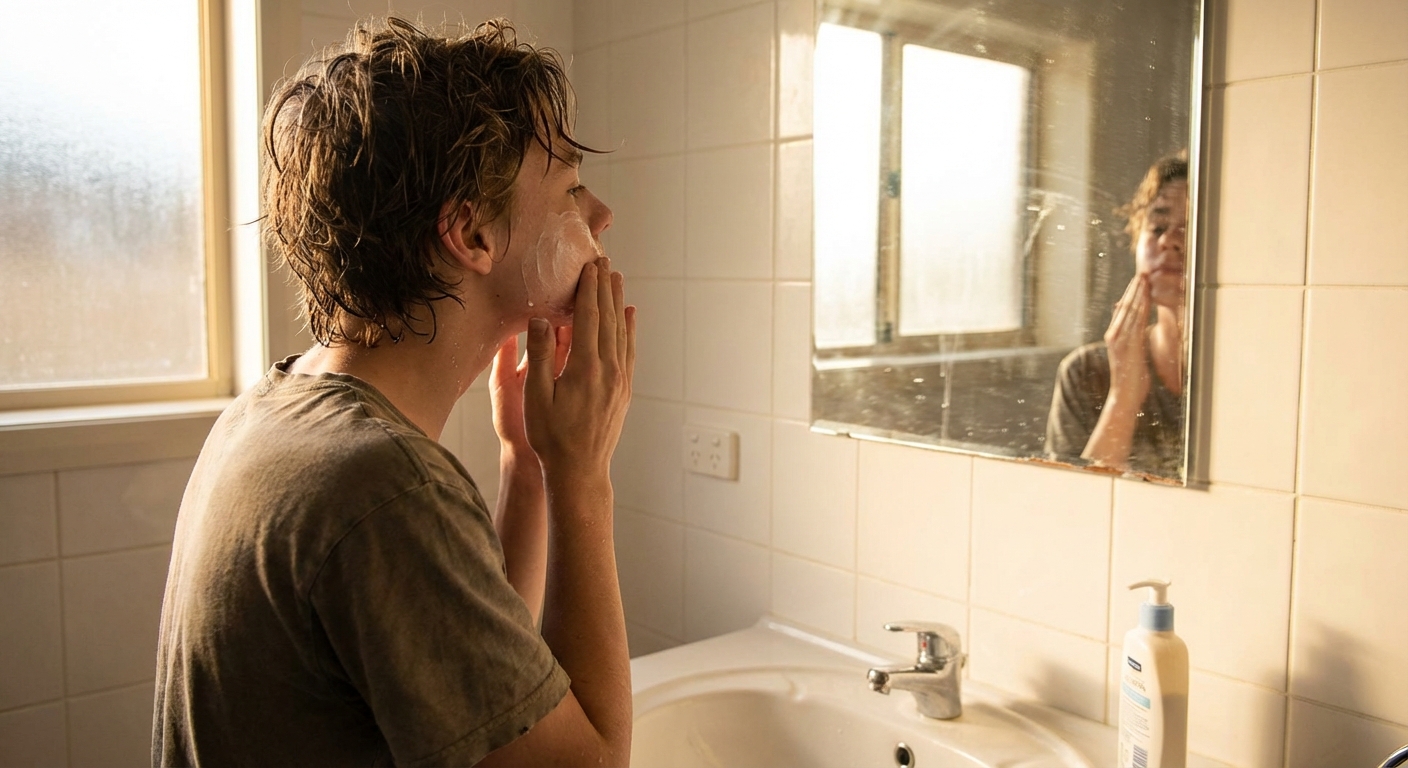
Apply to damp skin. This is the one thing I wish someone had told me years ago. Right after you wash your face, pat it with a towel until it's still slightly damp — not dripping wet, not bone dry. Just a little dewy. Moisturizers with hyaluronic acid work way better when there's surface water to lock in. If you apply to completely dry skin, the HA can actually pull moisture out of deeper skin layers, which is the opposite of what you want. Every single time.
Use a pea-sized amount. That's it. Seriously, that tiny amount. More product doesn't mean more moisture — it means more stuff sitting on top of your skin, mixing with sebum, potentially clogging pores. A little goes further than you think.
Wait between your acne treatment and your moisturizer. If you're using benzoyl peroxide or a retinoid, give it like 5-10 minutes to absorb before you layer moisturizer on top. I know, that means standing around in your bathroom doing nothing. Brush your teeth. Scroll your phone. Just don't slap everything on at once — mixing them immediately can dilute the treatment AND increase irritation. Worst of both worlds.
Don't forget sunscreen in the morning. Moisturizer and sunscreen are two different jobs. Some moisturizers include SPF, but the coverage is usually not enough. Layer a separate SPF 30+ sunscreen on top of your morning moisturizer. Yes, it's another step. Yes, it matters — especially if you're on retinoids, which make your skin significantly more sun-sensitive. Your future self will thank you for this one.
Bottom Line
Your acne-prone skin needs moisture. Fighting that fact just creates a cycle of dryness, overproduction of oil, and more breakouts. The number of teens I've talked to who skip this step and then wonder why their acne treatment isn't working...
If you want one product that moisturizes AND fights breakouts, the Norse Organics Pimple Stopper Day Balm is the best thing we've found. If budget is tight, CeraVe PM is the easiest drugstore pick for a reason. Either way — apply it to damp skin twice a day, and give your barrier the support it needs to actually let your acne treatments do their job. It's not glamorous advice. But it's the kind that actually clears skin.
How we reviewed this article:
Our experts continually monitor the health and wellness space, and we update our articles when new information becomes available.
- Epidermal Barrier Function and the Role of Ceramides in Atopic Dermatitis and Acnehttps://pubmed.ncbi.nlm.nih.gov/29858839/
- Skin Barrier Function and the Microbiomehttps://pubmed.ncbi.nlm.nih.gov/30999230/
- Niacinamide: A Review of Its Topical Use in Dermatologyhttps://pubmed.ncbi.nlm.nih.gov/28220628/
- The Role of Moisturizers in Addressing Various Kinds of Dermatitishttps://pubmed.ncbi.nlm.nih.gov/28585191/
- Hyaluronic Acid: A Key Molecule in Skin Aginghttps://pubmed.ncbi.nlm.nih.gov/22052267/
- AAD: Acne Clinical Guidelinehttps://www.aad.org/member/clinical-quality/guidelines/acne
- Comedogenicity of Current Therapeutic Products, Cosmetics, and Ingredients in the Rabbit Earhttps://pubmed.ncbi.nlm.nih.gov/6229554/
- Effect of Niacinamide on Sebum Production and Pore Size in Asian Skinhttps://pubmed.ncbi.nlm.nih.gov/16766489/
Read This Next

At-Home Dermatology Tools: Gua Sha, Jade Rollers, and Acne Devices
Most at-home skin tools are luxury items, not acne treatments. Here's an honest look at what works, what's harmless, and what can actually make things worse.
Read More →
Vitamin C Serum and Acne: Brightening Without Breaking Out

Ceramides and Acne: Why Your Skin Barrier Is the Foundation

Probiotics for Acne: What the Science Actually Says (So Far)
The gut-skin axis is real and the early research on probiotics for acne is interesting. But 'interesting' and 'worth spending $30/month on' aren't the same thing. Here's what we know and what we don't.
Read More →
Hormonal IUDs and Acne: Why Some Birth Control Makes Skin Worse
Levonorgestrel IUDs like Mirena and Kyleena can trigger or worsen acne because of their androgenic progestin. Here's why it happens, what to do about it, and how other birth control options compare.
Read More →